Time rich, money poor

Image

Time rich, money poor

My plan is to have every unit in my collection kitted out with a movement tray. This has been easy for Warhammer Fantasy Battle, Black Powder and Field of glory. I spent the last few months at my last job, when I knew I was being made redundant, making stuff in the workshops. Three aluminium/brass carry cases and more movement trays than you can shake a stick at. They’re easy: a rectangle of plastic cut to the right size, a border strip made of six mil plastic and a thin sheet of mild steel cut to the unit’s size. Glue together, Dremmel sides, superglue some sand on and undercoat. Job done, ready to be painted up when the unit is ready so that the bases match the movement tray.
Now with 40K and Bolt Action there are round bases. Not so easy. 40K uses, for the main, twenty five mil circular bases. Bolt Action uses two pence coins. Foreign readers may question why so many English wargamers use money to base there figures on. Are we extravagant? No, the answer is that the two pence piece is more enough worthless. Plastic bases cost more to buy. Plus, if you get the older coins, they are attracted to magnets. Another love of mine is magnetised units, I have seen plenty of instances where an opponent has placed a unit on a hill only to see them slide away. Not me, I’ve magnetised more or less everything.
Anyway back to the circular based movement trays. 40K has twenty five mil bases and Bolt Action has twenty six mil bases. So what is one millimetre between friends? I don’t think anyone will notice a slight gap on my 40K units between base and movement tray.
OK. Time rich money poor. That’s me, plus I’m a tight bastard. I have seen some laser cut trays on Fleabay for between two and three pounds each, plus postage. I’ll probably need thirty odd. So the money mounts up. So what does one of these fancy laser cut movement trays consist of? Two sheets of MDF. The bottom one is plain and the top one has holes cut in it.
What am I not capable of doing?
I drew up some templates in Indesign, just to work out the size of the base. A ten man movement tray worked out to be ninety five mil by one hundred and thirty mil. Wouldn’t mind some five man movement trays and some twenties. Bauhaus has one square metre of three mil not-quite-MDF for four Euro something. From this I can get thirty nine movement trays. Went to Bauhaus on Monday morning armed with cake to bribe the wood cutter. Got the wood cut and purchased a twenty six mil hole cutting attachment for my drill. In all it came to twenty one euros on the nose.
All that is left is to drill the holes for the bases, stick them together and finish as appropriate for the unit.
The biggest chunk of that was the drill bit at Fourteen something Euro. But I have that now, so any time I want more movement trays it’s just the cost of the wood, which is minimal.
Result!
Black Powder Command Group

Image

Black Powder Command Group

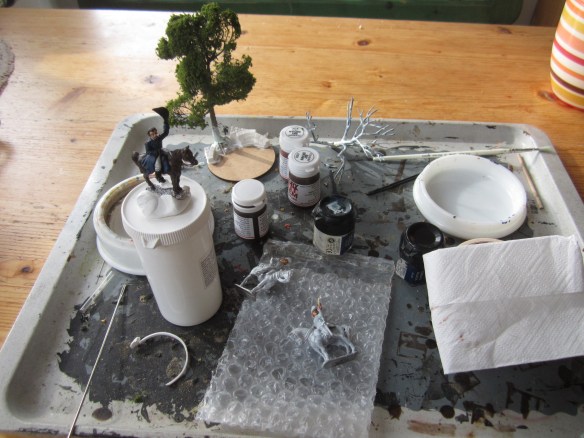
Next project on the workbench. A command group for my British Peninsular Napoleonic army. I have been prevaricating about starting this project as Napoleonic wargamers have a reputation of being very picky about accuracy.
If I can do my Napoleonics well and get some praise for them I reckon that I can consider myself an OK painter.

Schnee

image

How I made snow bases for my models.

I’ve been experimenting with baking powder and PVA for my Flames of War army and it was fairly pleasing.

Seeing as my painting has gone up a notch I wanted to do the same for my bases. After a couple of false starts I’ve come up with the following recipe.

Note to self. DO THIS AFTER VARNISHING!

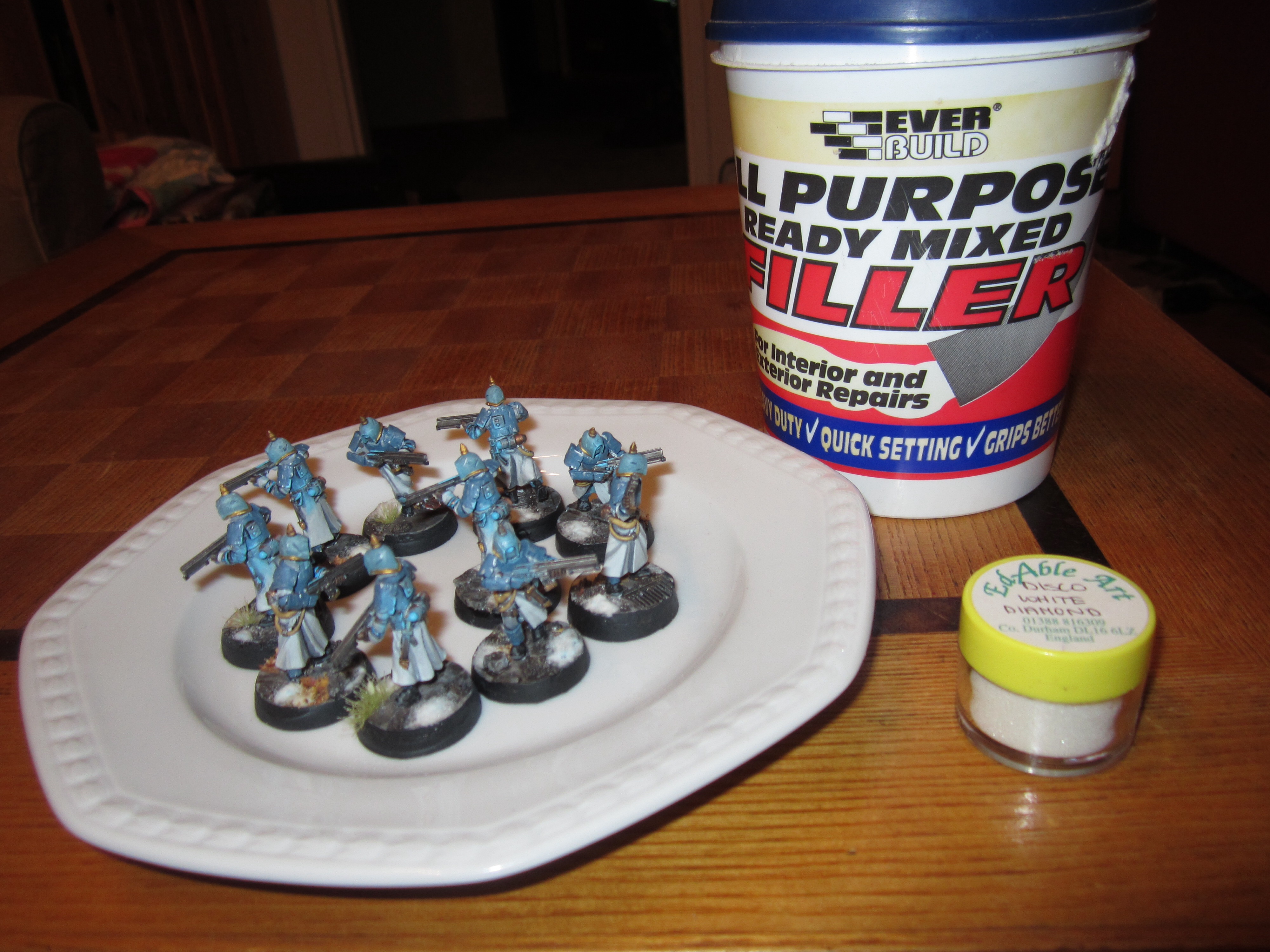
Put some blobs of  ready mixed filler on the base. If you dilute it a bit it looks slushy. I found this filler in my shed and had a bit of a play around.

Next a very gentle sprinkle of  cake glitter. I tried a few of my Wife’s and settled on the white.

Finally a weak wash of GW’s Ice Blue in the areas where there would be shadows.

image


Work in progress

Here is the next project I’m working on.

Image

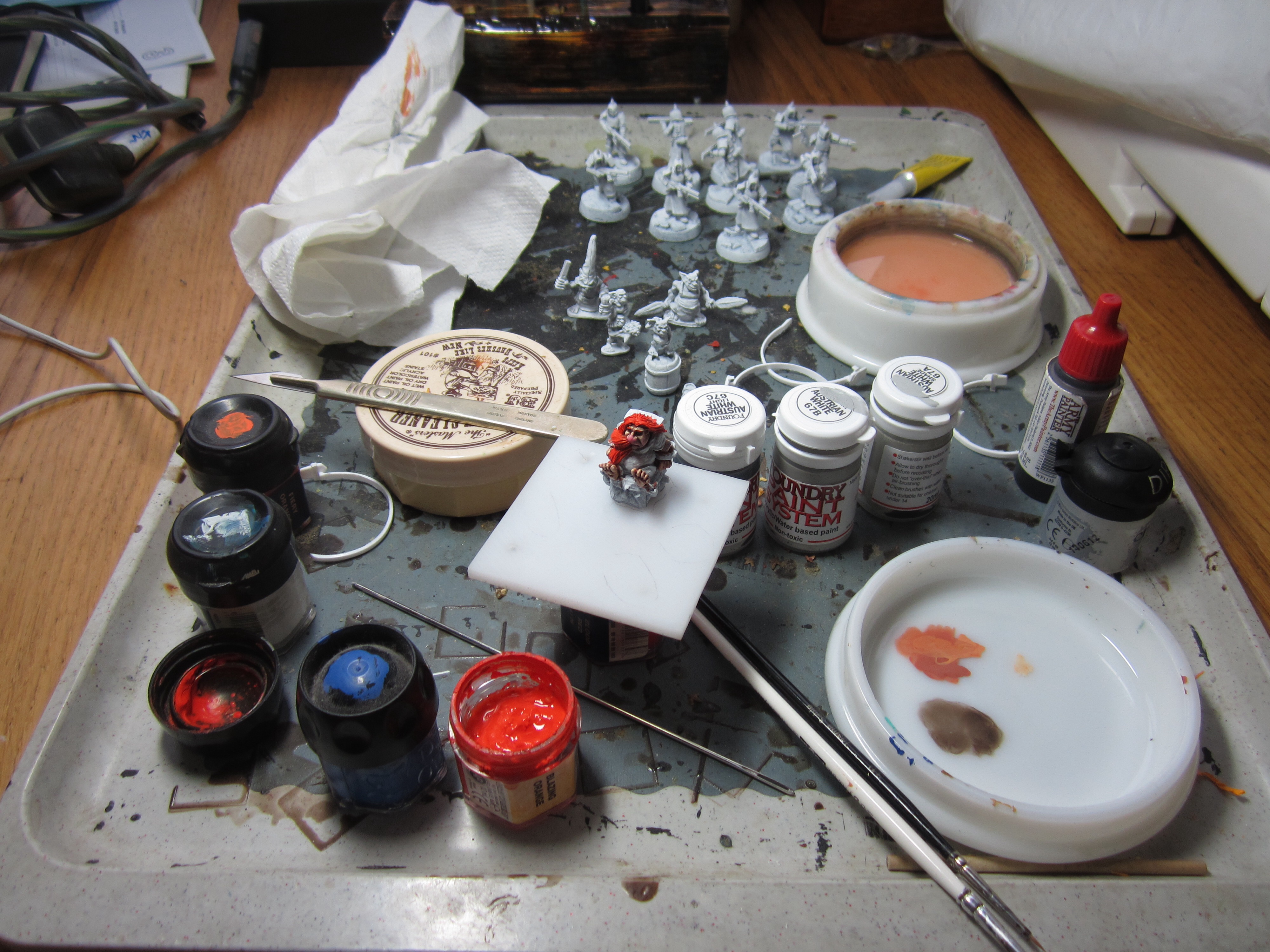
You can see in the background a squad of Tox Troopers from Anvil Industries. I often undercoat several projects in one go.

Just picked up a GW brush to block in some colour. Absolute shite. I’d picked a few up at the Artisan’s workshop a while back. At the time they had to give me a non GW detail brush because I complained so much about the quality. Still it’ll do for glue or something.

One down, how many to go?

Image

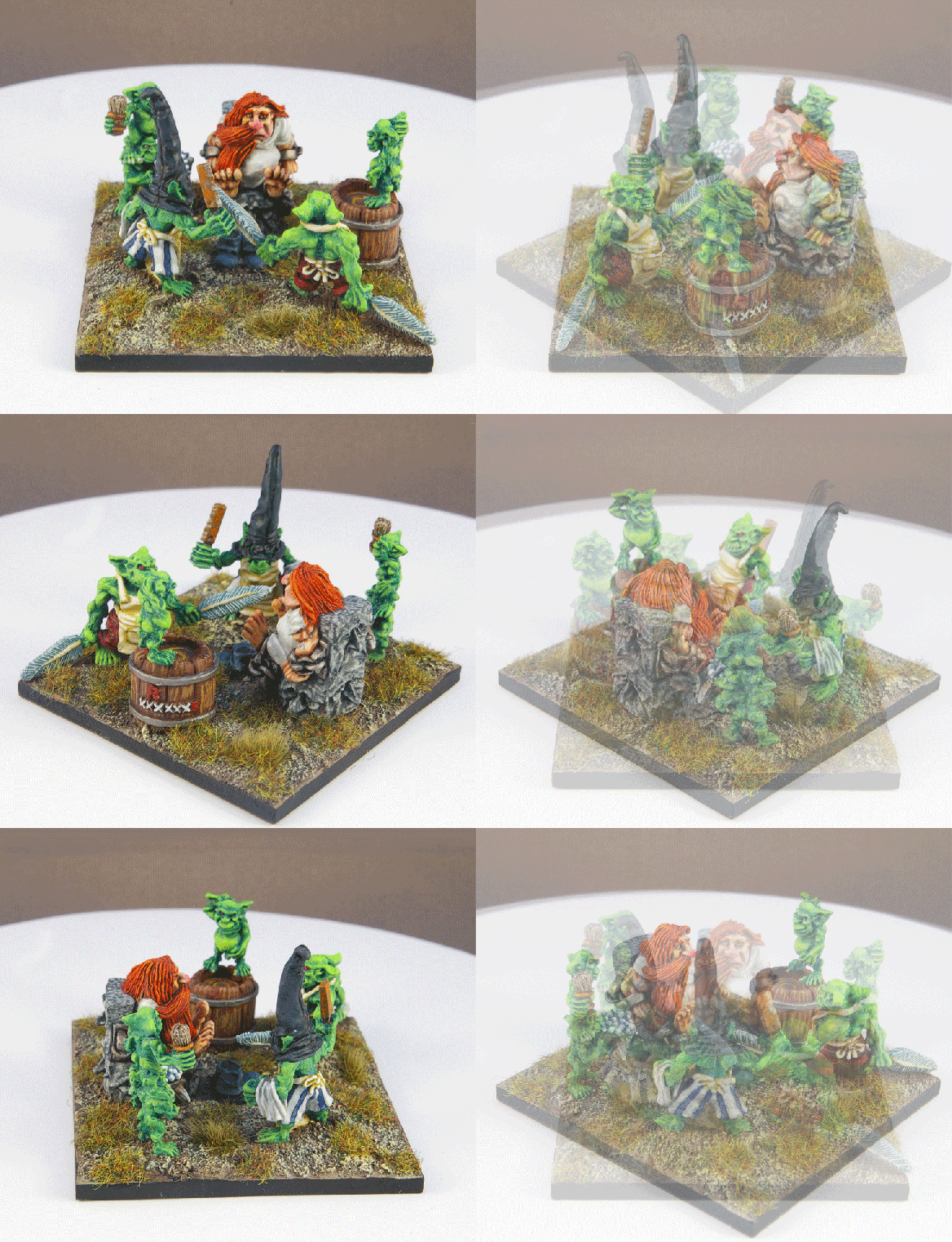
Here is the first unit finished in Austria. A unit of Halflings, made by Battleforge, for my Albion army. The sculpting isn’t amazing, but they are so full of character and fun that I’d rather have these than a unit of dull but amazingly sculpted figures.

I had a lot of angst about finishing this unit. I had started painting them before I left Blighty and I had promised myself that when I got my stuff this was to be the first unit I’d paint. When I unpacked them I did a double take. The quality of the painting was so much higher than I thought I could do. Could I match it? I wasn’t sure and spent a while prevaricating before sitting down and starting.

The end result is good, but still not up to the standard I set.

I used a couple of new techniques that I have mentioned previously.

Microplaned sponge, I’m fairly pleased with the result, though you have to make sure that the particles are really fine.

Tester pots for the basing, this works well and I am pleased with the result.

I have started cataloguing and photographing, more work needed on the model photography. When the website is live I’ll post the address.Image

So here is unit WHFB/A/1/numbers 1 to 30.

Making a Wet Palette. Part One

This is very much a work in progress and some revisions may have to be made.
The Tabletop Minions video blog inspired me to start this project.

Here you can see I have assembled all the components I’ll be using

Here are the bits I need for this project

Here are the bits I need for this project

First off is an airtight food container, sourced from Morrisons. It’s not huge, about 12cm by 9cm.
A piece of card cut to the dimensions inside the the container. This is used as a template for cutting.
Scalpel, spare blades, steel rule and a cutting mat. The cutting mat is essential if you wish to maintain cordial relations with your nearest and dearest.
A short length of speaker cable, donated by my local electronics store.
One roll of baking paper. I don’t know if this is the right stuff or whether I need baking parchment. I’ll report back.
A pack of sponge cloths. Again I’m not sure if they’ll work.
I neglected to add a schilling coin which I use to cut around the corners of the sponge and paper.

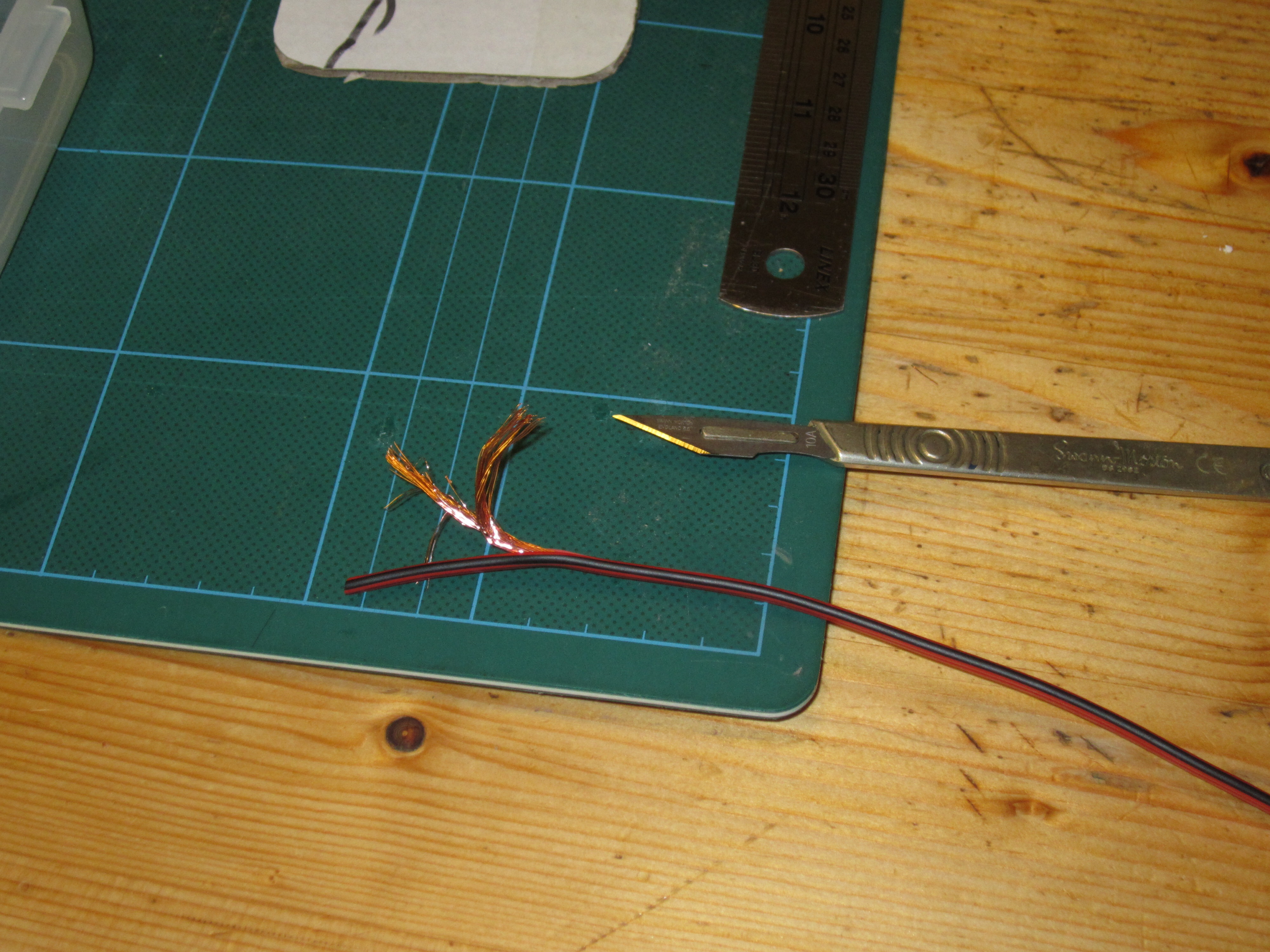
Stripping copper wire

Stripping copper wire

The first thing I did was to strip out the copper wires from the speaker cable. I recently read a post on Frothers Unite where a member had sourced some parts to make some wet palettes. He had put some copper wire in them to dissuade mildew from growing.
Quick question? Where do people store their wet palettes? In the fridge? Obviously nowhere warm which would dry the paint and be a hothouse for the growth of any fungal nastiness.
He also mentioned that his containers were fairly shallow so that was no annoying reach down into a sandwich box.
“Ah Ha!” Thought I, this is why I have several layers of sponge cloth built up so the painting surface is almost level with the lip of the box.

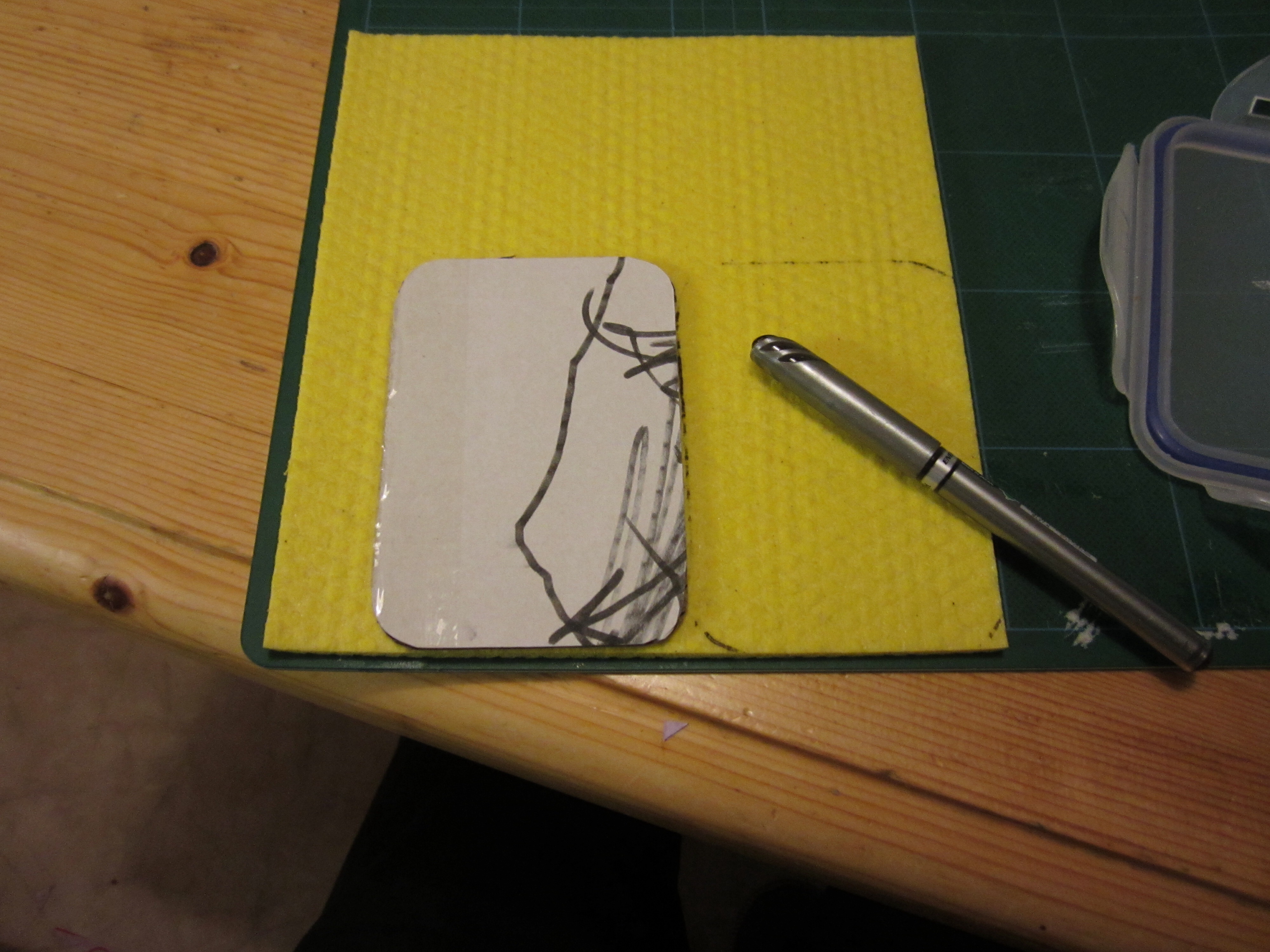
Marking the sponge cloth for cutting

Marking the sponge cloth for cutting

Next, using the template, mark out where to cut the sponge. A good idea is to align the template to as many edges as you can. Thus avoiding any unnecessary cutting and ensuring that at least one corner is exactly square. Really I should have aligned the second set of cut marks to the left hand side of the sponge. It would have only been one more cut more.

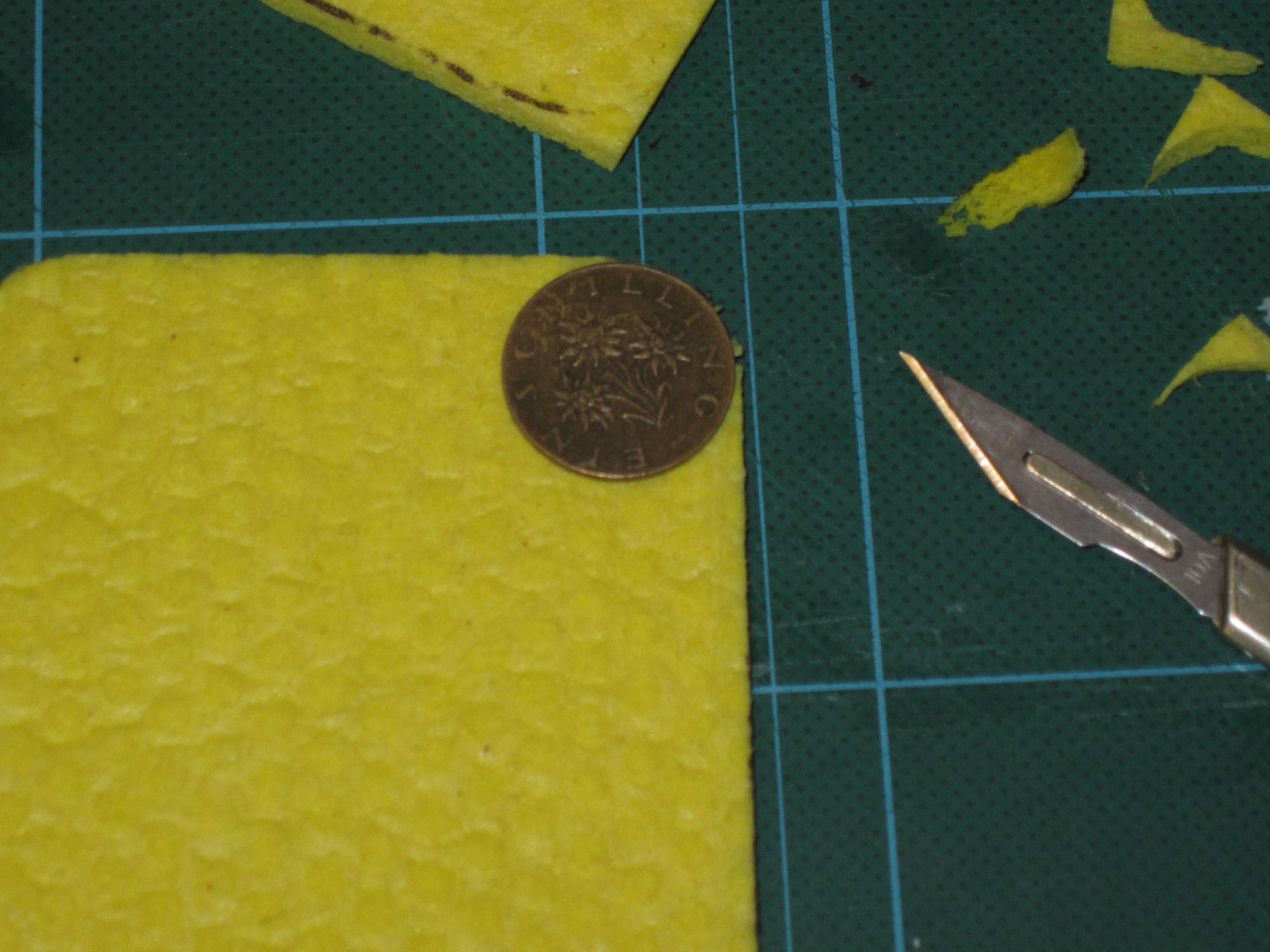
Cutting the corners

Cutting the corners

Then using the schilling cut round the corner of the sponge. The advantage to having layers (six in my case) is that you can achieve a much neater edge rather than the sort of hacked about look that thick sponge gets.
Now wash the sponges out. There is something on them that makes them feel weird.

Copper wire

Copper wire

Strands of copper wire are laid between the layers of sponge.

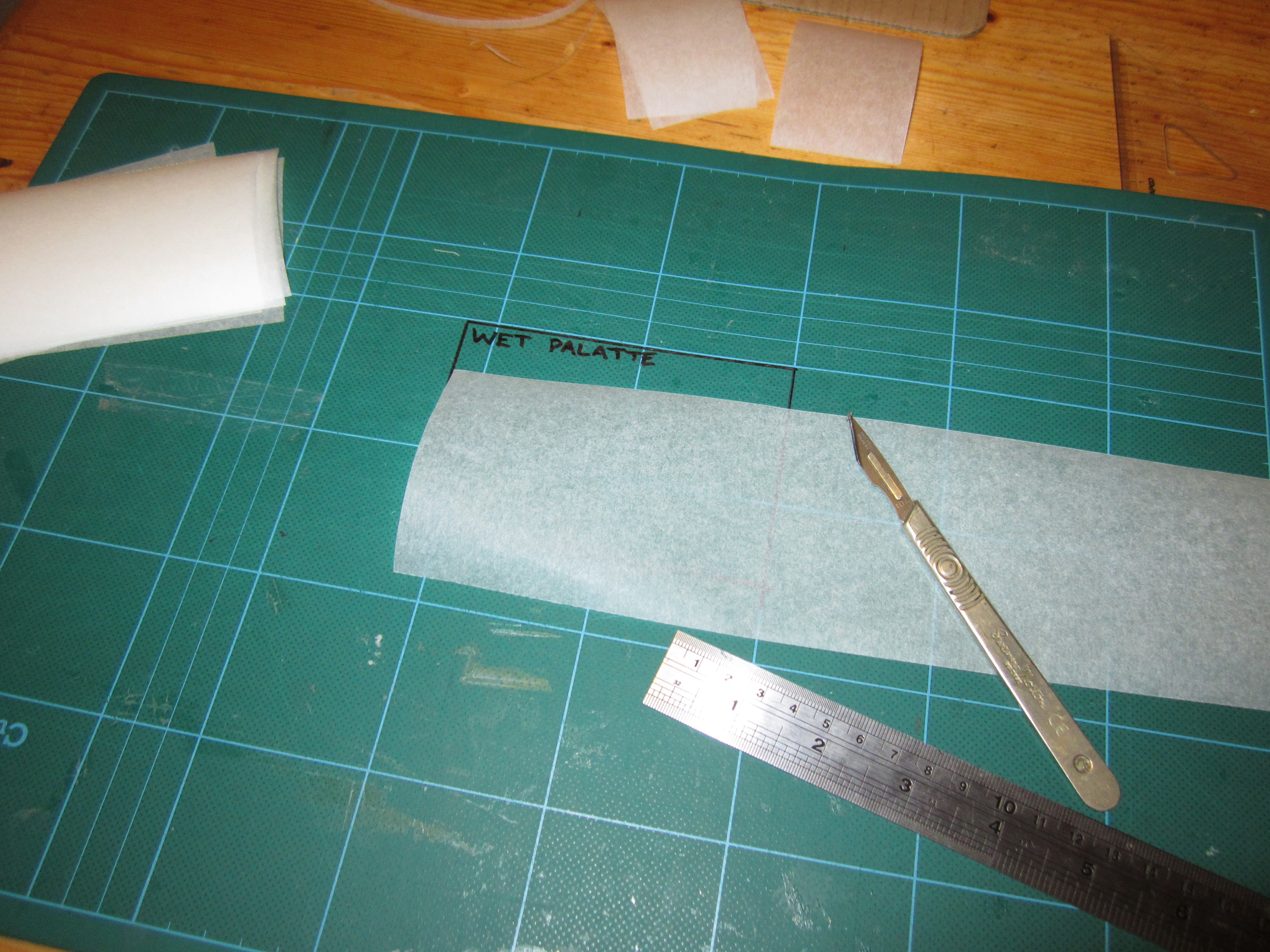
Cutting the baking paper

Cutting the baking paper

Now to cut the palette surface, the baking paper.
See how I have drawn a template on my cutting mat? The mat has right angles printed on it. In under an hour you can cut up enough paper and trim the corners for a years worth of painting.
Find an envelope for the spare sheets and write down where you’ve stored them.

Predictions for 2014

I’ll put my money where my mouth is and offer a glass of decent red wine if this doesn’t happen.

This is based on me taking a small interest in Military Modelling and observing how that particular branch of the hobby is advancing painting techniques.

GW will introduce two, at least, weathering products. One will be a spray of chipping medium, Hairspray to you and me. And the other will be a Dust Wash or a Mud in a jar.

Just my ten pence worth.

Here it is! All of it!

All my stuff from Blighty

All my stuff from Blighty

Well my stuff has arrived from Blighty, courtesy of Simpsons Removals.
NEVER
EVER
EVER
USE
SIMPSONS
!
I paid for a dedicated packing service. What do they say about a fool and his money?
A cutlery drawer just upended into a box. My Wife witnessed this. And again bits from my workshop. Glass jars, hammers and screwdrivers. No attempt at packing or padding.
My Wife has a smashed food processor, and when you are a professional chef it is a nuisance.
I have smashed plastic cases from poor loading. There are nine boxes of toy soldiers and an electric guitar missing.
When I rang to complain I was told that they have been repacked. I requested the paperwork documenting this I was told that Simpsons don’t always tell the client everything that happens at the depot. That makes a nonsense of their advertised inventory system.
Simpsons Removals. Just say, “No!”

This is what a dedicated packing service really means

This is what a dedicated packing service really means

Be organised. Write it down!

Or how I learnt how to embrace my “Special”ness.

When I was younger I was much more arrogant and assumed I knew everything and could remember it all. Which was sort of true as I only had a few paints.
With age comes (lack of) wisdom. I now have a fair few pots of paint and a need for consistency. Did I use a Games workshop paint? Or a Vallejo or a Foundry?
My answer, notebooks. Six of them! Seven if you count my daily notebook which I use for everything.
The Show Book.
This was used for Salute and SELWG. I would get the list of traders from the show website and visit every traders website. If they were selling anything of interest I would note down the price, catalogue number and stall location. Once I had drawn up my shopping list I would print out a map of the show and highlight the traders I wished to visit. This was so useful, especially at Salute as it was so huge. Before this I would lose track of who was selling what and this book allowed me to keep a tight rein on my budget.
The Recipe Book.
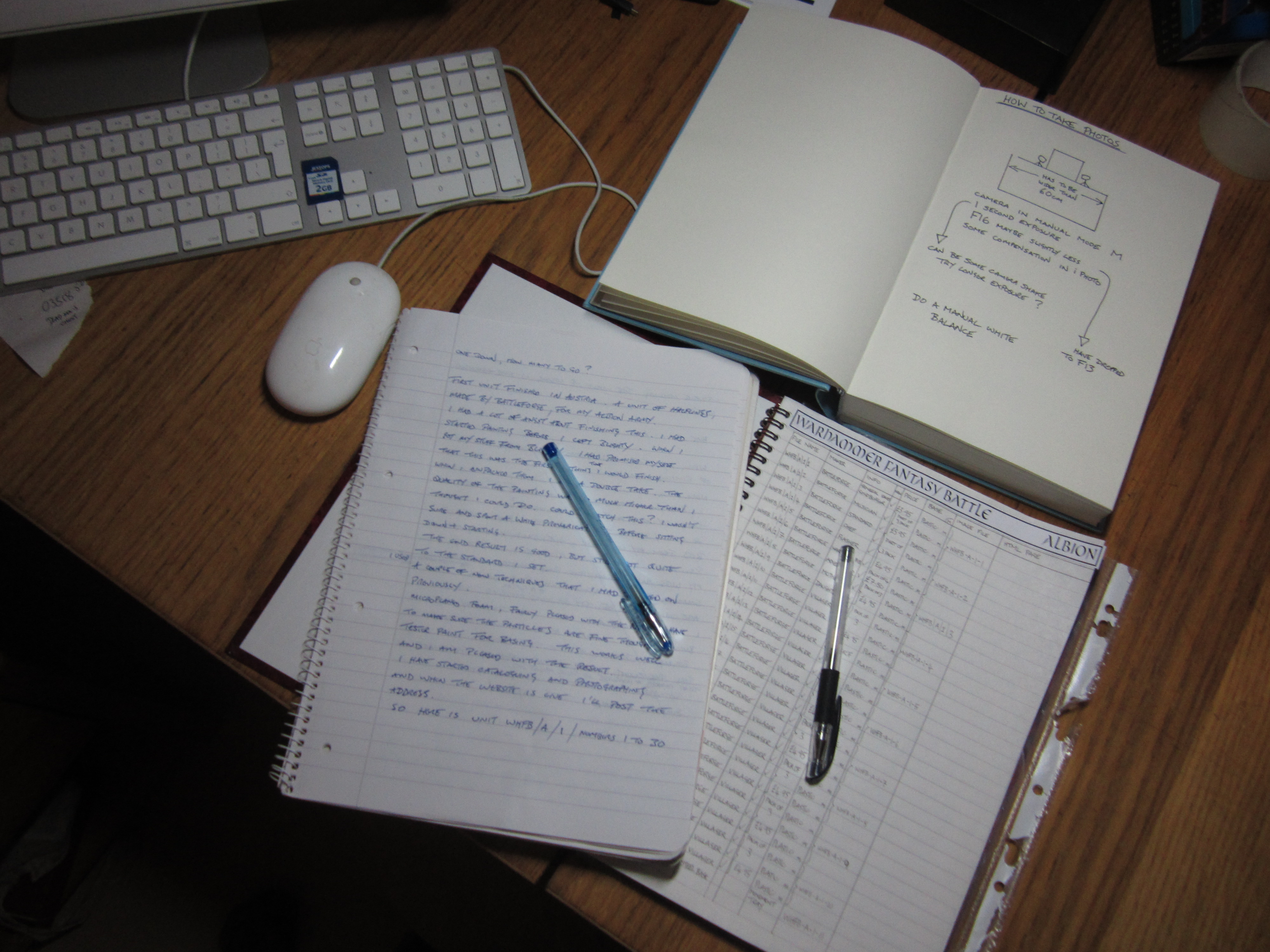
This is the most useful of the lot and if you want to take any advice from me, take this! This is where I write down how I have painted a particular unit or achieved a certain effect. I suppose consistency isn’t so important for fantasy armies, but for historicals it’s vital.
The Ideas Book.
Where I record interesting articles on painting, ferinstance… gold or a nicely painted example of a figure I’ve got in the lead mountain. As I have a growing library of books and magazines I want to keep track of where everything is. So an article on painting gold, So I go to the “G” section in my Ideas Book write “G1” with a description and what book/magazine it in and page number. Then I stick a Post-it in the appropriate page of the book/magazine.
The Book of Everything.
In this book I write down all sorts of extra information. Server configuration for my website. File names of web pages and layout details. Suppliers addresses. How to set up my camera for photographing models. Information that doesn’t have a home anywhere else.
The next two books haven’t been started yet. I don’t have any clear idea of how big my lead mountain is. There are boxes all over the place. It would be a good idea, not only for insurance, but also to stop replicating any purchases.
The first of these two is The Painting List. Once I’ve got all my bit shipped over and got a permanent place to live my first job will be to unpack everything, itemise them and assign each unit a number.
As I finish painting a unit this information will be transferred to the second book, The Catalogue. Each figure will have a unique number and details of cost of figure, manufacturer, photo reference number and price.
This is where I am having some difficulty.
How much do you value your work at?
I’ve looked at professional painters websites and I reckon I’m around the ten pound mark per historical figure. The waters were tested on Fleabay where two figures were sold for around nine pounds each on auction.
Once you start doing the math my lead mountain starts getting scarily expensive. My Napoleonic army when finished starts hitting the two and a half thousand pound mark.
I’ve no idea on fantasy prices, so I am thinking of a base price of five pounds per figure. Again scary numbers, my Night Goblin Regiments alone would pull in eighteen hundred pounds.
Anyone got any thoughts on this?
I would appreciate feedback from someone who has insured their collection.